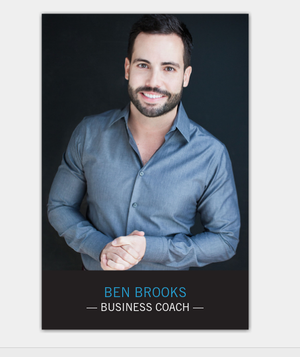
Ben Brooks usually asks the questions on The Lift, but this week the show’s Executive Producer Steph Colbourn takes the host chair and interviews him about why three out of four change initiatives fail and why communicating change is not the same as managing it. He walks through the five-stage Change Path and William Bridges’ Four Ps, and shows how to bring people into a change so it sticks.
Why Change Efforts Fail Even When the Plan Is Sound
When Ben worked in the corporate world, his company rolled Salesforce out across a hundred countries. The goal was to centralize sales data that people kept on their own computers, so the company could see who was performing and have everyone work consistently.
On a business trip, Ben found that the Singapore office had the highest adoption, and his boss in New York told him to figure out why. The office manager had set an Outlook reminder asking everyone to log in on the 27th of every month. The adoption metric was the percentage of employees who logged in once a month, so her office met it. They looked as if they were leaning into the new system, when really they were making sure they were not on the bad list. The push had come from the top down, and it produced compliance instead of change.
That pattern is common. Depending on the statistic, about three out of four large scale change initiatives fail, and more than three quarters of mergers and acquisitions destroy shareholder wealth over time. The technology is usually good. The failure is adoption, and people resist what is compulsory.
Communication Is Not Change Management
One of the biggest mistakes in change management over the last 20 years is the assumption that organizations only need to communicate. A guest on the show described a monologue as speaking from the assumption that you hold the truth, and a dialogue as assuming the truth is shared among the people in the room. Most change communication is a monologue with more context: why this is happening, when it happens, what people must do and how it ties to strategy. That is glorified high context communication, which is necessary but not sufficient to get people to want to do the new thing.
Timing adds to the problem. Ben once ran a five mile race in Central Park with about 10,000 people. Everyone ran the same course, but some runners started 20 minutes before those at the back. An executive team may spend months researching and debating a decision before announcing it, so for everyone else it is brand new news. A big part of the work is bringing people along from wherever they are on the course.
The Change Path
The Change Path has five stages, and each one brings more people in, like a funnel that is tiny on the left and wider on the right.
Uncover. Everyone agrees that something needs to change before anyone proposes a solution. HR, customer service and finance each hold different information, so this stage pools it into one shared picture. It can start with a 10 person executive team in a 10,000 person company.
Codify. This stage defines the current state, the desired future state and the reasons for the move. A perfectionist organization that needs to move faster might codify that good enough is now good enough. The definition is drilled down with a broader group, including the people who will be held to it, so everyone shares the same yardstick and language.
Activate. This is the launch, offsite or town hall. It builds excitement and lets people experience the change in a positive way through initial skill building and a quick win. It does not open with an instruction to log in differently.
Anchor. The codified standard becomes the daily reality, which typically takes years. A new airport has runways you can measure, while culture is harder to see, so people think they are done before the data says so. Anchoring means making the right thing easy, giving feedback, and recognizing and rewarding people so the change does not depend on willpower or memory.
Evolve. Whatever an organization changes into will not last forever. A new CEO, a market shift or a regulatory change can alter the culture it needs, and the culture of 2020 is probably different from the one needed in 2027. The path then starts again at Uncover.
Uncover and Codify together take about 10% of the effort, expense and time, and the other 90% goes to Activate, Anchor and Evolve.
The Change Path Applied to Decision Rights
At an offsite with a PILOT customer’s executive team, people kept saying “no, you’re the decision maker on that” to one another, until they asked who decides who the decider is. Eventually the CEO said she did. Two people had each assumed the other was responsible.
In Uncover, the team found that decision rights, role clarity and ownership were vague across the organization, and that many people feared a mistake enough to avoid deciding. In Codify, they defined what clear decision making would look like. In Activate, they applied a decision making framework to items that had been stuck and resolved one they had struggled with for eight months in two hours. They earned a C minus, which is a passing grade, and the win was about an outcome that mattered to them, not about the framework.
William Bridges’ Four Ps
William Bridges, one of the grandfathers of change management, described four Ps for a strong change conversation.
Picture. Where are we going? The picture is a vacation to Hawaii.
Purpose. Why are we going? It was a hard winter, or the team won its sales goal.
Plan. The plan makes the trip believable, especially when it admits that earlier attempts went wrong.
Part. Everyone else needs a part to play, and leaders most often skip this one.
Most organizations do change like the Nickelodeon slime bucket. The change is the slime, and it gets poured on employees’ heads. People who are passive spectators can only wait and resist, while people invited onto the course help shape the change and own it. This is the IKEA effect, in which people who build their own furniture value it more.
The Helicopter Paint Shop
When Ben was a management consultant in an aviation practice, his team was sent to a client in Canada that was one of the largest helicopter operators in the world. Every day a helicopter sat on the ground cost the operator profit. As the young person on the team, Ben got the least glamorous assignment, the paint shop.
Painting a helicopter that seats eight took 28 days, while a 747 that seats 500 takes 11. Ben started by listening. The light was poor, so painters sanded twice. Management had removed the coffee maker, so coffee meant a mile walk. The safety equipment was not set up for a chemical wash after an injury. The team codified a goal of 20 days and started with what mattered to the people in the shop. Ben got the coffee maker back and ate lunch with the crew in the cafeteria, and the team brought in electricians, so within a day the lighting was better. The shop reached about 22 days.
Four or five years later, the person in the paint shop called Ben. They had reached 12 days and believed they could reach eight, which was more ambitious than the target the executive team had set. Injuries were down and the ergonomics were better. It was their change, and it had become what was normal in the shop.
When to Evolve
Constant disruption burns people out, so move to Evolve only when the context has materially changed, such as a sale, a merger, new competition or a turn in the economy. Between those moments, keep the main thing the main thing. Consistent language and focus gives people who are waiting out the latest priority a pattern they can trust.
What to Do This Week
Uncover. Find out where you are. Get everyone working from the same information, agree on the problem and share it with every person who matters.
Codify. Define the future state, not only the symptoms, and agree on one standard that everyone could repeat out loud with their eyes closed. If writing is not your strength, record it or use AI.
Activate. Invite people onto the course instead of sliming them, and let the people who want to move fast set the pace.
Anchor and Evolve. Praise what you want to see, ask what is in the way when something is off, and build the standard into reviews, hiring and training. Slow down and start again at Uncover when the bigger context changes.
Related Episodes
Stay Connected with The Lift
Subscribe to The Lift on Apple or Spotify
Join our mailing list
Follow Ben on LinkedIn & Instagram (& Jetson, too)