Episode 35 - Spend Your Credibility Wisely: Rob Powelson on Making an Unpopular Call
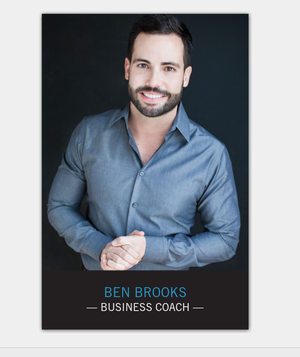
Rob Powelson has spent his career inside regulatory fights where the pressure came from people with considerably more power than he had. He joins Ben Brooks to discuss the Fourth of July call that ended a lobbying campaign, the coal bailout he voted against despite the administration that appointed him, and what it means to treat your credibility as a finite account.
Spend Your Credibility Wisely: Rob Powelson on Making an Unpopular Call
Every leader eventually lands between a rock and a hard place. The people around them push in one direction while their own judgment points the other way. What separates the leaders who come out of those moments intact is not stubbornness. It is a working sense of what their credibility is worth and when it is worth spending.
Rob Powelson has tested that question more than most. He is President and CEO of the National Association of Water Companies, the trade group representing America's private water utilities. Before that he chaired the Pennsylvania Public Utility Commission, and then served as a commissioner on the Federal Energy Regulatory Commission after being appointed by President Trump during his first term. In both roles he found himself opposed by people with considerably more power than he had, and in both cases he held his position.
Credibility is a finite account
The premise worth starting with is that credibility does not replenish on demand. A regulator who says no to everything stops being a regulator and becomes an obstacle. A leader who fights every battle has no standing left for the one that matters. Powelson describes his own approach to regulation as balanced rather than reflexive, and that balance is what made his refusals land when he issued them.
This reframes the usual question. The question is not whether a leader has the courage to take an unpopular stand. It is whether they can tell which stands are worth the cost, and whether they have done the preparation to make the stand defensible when it arrives.
The three-minute call
The clearest illustration involves Uber's entry into Pennsylvania. The company began operating in Pittsburgh before it had been certificated by the commission, which meant its drivers had not passed background checks and its vehicles had not met the safety standards written into the public utility code. Powelson's staff had warned the company's lawyers and management directly. The company went live anyway. The commission, having anticipated exactly that, ran a sting operation.
What followed was a lobbying escalation that any executive will recognize. Rather than negotiate with the agency, the company took the matter over the agency's head. Powelson's phone rang over the Fourth of July weekend while he was with his family on the Eastern Shore of Maryland, and the Pennsylvania governor was on the other end asking for an explanation.
The handling of that call is the part worth studying. Powelson did not defend the commission's authority in the abstract and did not argue about jurisdiction. He asked the governor to view the situation through the lens of his own prior role as the state's attorney general, then laid out the specific risks in concrete terms. Drivers without background checks. Vehicles with worn brake pads. Passengers in the back seat of both. The conversation lasted three minutes, and the governor understood the position immediately and supported it.
Two things made that possible. The first is that Powelson had a factual case rather than a positional one, which meant the exchange never became a test of wills. The second is that the relationship already existed. A governor who trusts a regulator's judgment can afford a three-minute call. A governor who does not will need considerably longer, and the outcome will be less certain.
The same episode also shows what restraint looks like on the other side of a win. When the commission moved to penalize the company, the proposed fine ran to twenty-five million dollars. Powelson argued his colleagues down from it. His reasoning was that the company had behaved badly but that punishment on that scale was disproportionate, and that he wanted the service in the market. The eventual outcome vindicated the judgment. The company was certificated, and Pittsburgh became a center for its driverless vehicle research.
Preparation is what makes a position defensible
Powelson did not improvise his way through the Uber question. Watching the company's rollout move east from California, he called the chairman of the California Public Utilities Commission and asked to be walked through how that state had approached the problem, including what had not worked. The request was practical rather than deferential. He wanted to arrive at the fight already knowing the terrain.
That habit is available to any leader facing a decision that someone else has faced first. Regulatory agencies borrow from one another across state lines because the alternative is learning the same expensive lesson fifty separate times. Organizations tend to be worse at this than regulators are, largely because asking a peer how they handled something feels like an admission rather than an efficiency.
It is also worth noting where Powelson placed the blame for the disruption itself. When the incumbent taxi companies came to his office to complain, he pointed out that they had failed to meet their own tariff obligations for years, missing pickups for families and for seniors travelling to medical appointments. Their lack of innovation created the opening that a competitor walked through. Sympathy was not on offer.
Holding the line against your own side
The higher-stakes example came at FERC. The Department of Energy, with pressure from the White House and the Senate majority leader, proposed what amounted to a subsidy for struggling coal and nuclear plants. Powelson, a lifelong Republican appointed by a Republican president, opposed it.
His objection was structural rather than partisan. Subsidizing plants the market was retiring would create a moral hazard, delay inevitable closures, and pass the cost to ratepayers. He characterized the design as capitalism on the way up and socialism on the way down. The commissioners, who came from different political backgrounds, concluded together that the Federal Power Act did not support the proposed path. Rather than simply refuse, they took the substantive concern seriously and studied grid reliability, building a record instead of issuing a rejection.
That distinction matters for any leader declining a directive from above. A no with nothing behind it invites a second attempt. A no accompanied by a documented alternative process is much harder to reverse.
What the position costs
Public service carried expenses that rarely surface in the public accounting. Powelson's wife forfeited a stock match in her retirement account because he might one day rule on an asset owned by her employer's parent company. Regulators face stay-out provisions restricting whom they can represent after leaving. Powelson defends all of it as common sense, and the pattern is worth naming: the leaders who are trusted with consequential decisions tend to be the ones who accepted constraints before anyone asked them to.
The infrastructure nobody examines
Powelson's current concern is the one most of his audience has never considered. There are roughly 51,000 drinking water systems in the United States, about 85 percent of them municipally owned, compared with around 3,200 electric distribution systems. That fragmentation makes oversight extremely difficult, and unlike the power sector, the water sector operates without cybersecurity standards.
The threat has already materialized. Actors across roughly eight states have targeted water systems, and they are not after customer data. They are after the industrial control systems that govern treatment and distribution. A Minnesota incident produced sewage discharges when pumps and valves failed to synchronize because the system had been overridden. The same access applied to treatment would produce a public health event rather than an inconvenience.
What to do this week
– Keep your answer short and factual when the pressure call arrives. The governor's call lasted three minutes because Powelson laid out the specific risk instead of defending his authority, and the shortest concrete version of the reasoning beats the longer defensive one.
– Anchor the decision to the standard rather than to the room. When a call is unpopular, go back to the fundamentals and the principles you have already committed to, and resist becoming a chameleon who reflects whichever room you are standing in.
– Ask someone who has already faced your decision how they handled it, including what did not work. Powelson called another state's commission chairman before Uber reached Pennsylvania rather than learning the same expensive lesson twice.
– Maintain the relationships you will need before you need them. Credibility accumulates in ordinary weeks and gets spent in extraordinary ones, and the work that made Powelson's three-minute call possible happened long before the phone rang.
Related Episodes
– Episode 14 - From Vendor to Trusted Partner: Marco Ziegler on Building Client Trust
– Episode 10 - Managing Yourself First: Margaret Andrews on Self-Awareness and Leadership
Stay Connected with The Lift
Subscribe to The Lift on Apple or Spotify
Join our mailing list
Take our listener survey
Follow Ben on LinkedIn & Instagram (& Jetson, too)