Episode 08 - From Fear Of Uncertainty To Strategic Advantage: Kut Akdogan On Navigating An AI-Driven World
In this episode of The Lift, Ben is joined by Kut Akdogan – entrepreneur, strategist, and Managing Partner at Gaussian Holdings – to explore how leaders can build strategy in a world defined by uncertainty, rapid change, and AI disruption.
Key takeaway:
Great strategy doesn’t eliminate uncertainty – it anchors it with a clear destination and moves forward through small, testable steps.
Other major takeaways:
Why humans are wired to resist uncertainty – and how leaders can work with that wiring instead of against it
How to define a clear “North Star” so uncertainty feels like crossing the Atlantic rather than drifting aimlessly at sea
Why traditional 3–5 year planning often breaks down in volatile environments
How to treat AI as a powerful tool, not a god or a gimmick
How to earn complexity by starting small, solving real problems, and scaling what actually works
How agile, incremental strategy creates stronger outcomes than rigid long-range plans
Why this episode matters
Uncertainty has become the water leaders swim in.
Markets shift overnight. Technology evolves faster than the planning cycle. And AI seems to promise everything while threatening everyone at the same time.
In this conversation, Ben and Kut unpack what uncertainty really is, why it feels so destabilizing, and how leaders can navigate it with more clarity, better judgment, and stronger strategy.
In this episode, Kut explains:
Why uncertainty has a “brand problem” in business
Why saying “I feel uncertain” is often treated like admitting weakness
How human beings are wired to crave both comfort and progress
How a clear long-term objective can make uncertainty more manageable – and even productive
Kut uses a powerful metaphor to underscore his main idea:
If you get in a boat with no destination, every wave feels existential
If your goal is to cross the Atlantic, storms are still stressful, but they make sensein context
For leaders, that means the first job is to define a North Star: a clear objective that stays steady even when conditions change.
A better approach to long-term strategy
Kut argues that too many organizations still build strategy as if the world will remain mostly stable.
He says that approach no longer works.
Instead, he advocates for “incremental moonshots”: pairing a bold long-term ambition with smaller, testable steps that allow you to learn, adapt, and course-correct over time.
Rather than pretending uncertainty is just a downside risk, leaders should build strategy that assumes change is coming.
That means:
setting a long-range direction
making smaller bets
creating room for adjustment
treating learning as part of execution
AI, strategy, and the danger of magical thinking
Ben and Kut also dig into the biggest source of modern strategic anxiety: Artificial Intelligence.
Kut is deeply optimistic about AI’s potential, but he is equally clear that leaders need to strip away its sci-fi mythology.
His view is simple: AI is a tool. A very powerful tool. But still a tool.
They explore:
why flashy AI demos often create unrealistic expectations
why “weekend experiments” rarely translate into real enterprise value
what the “95% of AI projects fail” statistic reveals about poor implementation
why leaders should stop using AI hype to justify eliminating roles they do not fully understand
how successful AI adoption starts with specific problems, not broad promises
Kut’s principle here is earning complexity:
Start with a real problem.
Run a contained experiment.
Create actual value.
Then scale.
What leaders should watch for next
In his “heat check” on the future of work, Kut predicts:
a more grounded correction in AI expectations
a new generation of entrepreneurs and intrapreneurs emerging from today’s uncertainty
winning organizations will be the ones that combine clear anchors with enough flexibility to experiment
He also shares a Moby-Dick quote that captures the restless, creative energy many founders and leaders feel when they are drawn toward difficult, uncertain work:
“It is not down on any map; true places never are.”
What leaders should remember
If you are trying to lead through AI hype, market volatility, or constant ambiguity, this episode offers a useful reframing:
You do not need to eliminate uncertainty. You need to anchor it.
Set the destination.
Take smaller steps.
Solve real problems.
And keep moving.
Links:
Full Transcript
Read the full transcript
Kut: Your objective is to cross the Atlantic Ocean, come hell or high water, right? That's very different to getting in a boat and being like, I don't know where this boat's gonna take me, the currents are gonna, you know, take me somewhere. And to do whatever it takes, no matter what the storms are, to get across the Atlantic will be a fraught journey and an uncertain journey, but at least a journey that you can measure and you can say, this is how we're doing. Uncertainty without an objective that is full like out at sea.
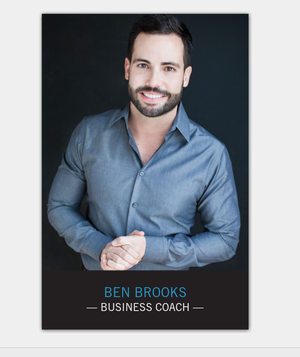
Ben: Welcome to The Lift, the show about leadership, growth, and getting what we want. I'm your host, Ben Brooks. For over a decade, I've worked with CEOs, their executive teams, HR departments, and entrepreneurs to identify what drives their success and what holds them back. And now I'm excited to share those insights with you on The Lift. We pull up to see the bigger picture from accomplished leaders who know how to get things done in a rapidly changing world. We've got all of that and a lot more coming up next on The Lift.
Sometimes being a leader, executive, CEO can feel like we're dealing in the Wild West. I remember as a kid playing The Oregon Trail, with the unknown challenges, the trade-offs, and the uncertainty along the way. And in today's modern environment, it's not that different. Work is constantly being shaped by external forces, new technology, endless data, and frankly, a lot of confusing signals. We're all just trying to find clarity in a world that changes by the minute. That's why I'm so excited to introduce you to Kut Akdogan. He's a managing partner at Gaussian Holdings, where he helps forward-thinking ventures like mine, PILOT, cut through the noise to solve real problems. Today Kut is gonna help us navigate through uncertainty — things like, how do we plan for the year ahead? Where do we invest? And like the Wild West pioneers on the Oregon Trail who came long before Kut or myself, he believes that great leaders aren't those who avoid ambiguity, but rather those who lean in to navigate it and even thrive within it. Well, Kut, welcome to The Lift.
Kut: Thank you for having me, Ben.
Ben: We like to start the show with a few rapid fire questions to warm us up. So outer space or the sea?
Kut: Very easy — outer space.
Ben: What's one of your favorite places on earth?
Kut: Ironically, probably by the sea, at a place that you know as well, on the west coast of Turkey — a little town called Alaçatı, one of the windiest places on the Aegean.
Ben: A beautiful spot that I've enjoyed as Mo as well with you. What was the first job you ever had where you got paid money for time or effort?
Kut: I was working at a tire factory. I was an apprentice engineer, I guess. Smelled a lot of tire, you know, rubber — fell in love with massive machines. It was great.
Ben: I've known you for over a decade. I didn't know that about you. What's one app that you cannot live without?
Kut: Home Assistant. It's sort of an open source alternative to Google Home and the other smart home sort of ecosystems.
Ben: Very cool. And when you think of your favorite kind of challenge — a creative challenge, a technical challenge, or a human or person challenge — which category do you feel energy around, your energy around?
Kut: Probably a mix between the creative and the technical. What do I most typically encounter the vast majority of the time? Probably human.
Ben: What's a word you'd use to describe the future?
Kut: Generally, the future is different.
Ben: Kut, you know, we've known each other for over a decade now, and you've been a critical advisor to my business and to my wellbeing, and one of the reasons I wanted to have you on The Lift was to talk about uncertainty. It's the elephant in the room, in every room, everywhere, all the time. And I wanted to first start with — if you were to kind of describe uncertainty as a brand, or kinda the positioning or reputation or association with uncertainty, what is that?
Kut: Oh, it's very negative. I mean, if you were to say, "I feel very uncertain," I don't think in our society that's viewed as a positive thing. The reaction is, "Hey, how can I help? How can I help you out?" Right? It's very human to want to be certain, and I think the desire for certainty creates sort of these knee-jerk reactions around uncertainty. It makes it a little hard to sort of exist in a world of increasing amounts of uncertainty. And it is increasing amounts of uncertainty, right? In many ways, change begets change, and change makes change happen faster. Whether we're talking things that are exponential or not, uncertainty is on the rise.
Ben: As humans, one of our superpowers is our evolutionary capabilities, so we've sort of got change built into our DNA in a certain regard, by virtue of the fact that we're still here. What is it about us that — if that's built into our success mechanism, why do we associate it so negatively or feel so bad about uncertainty?
Kut: We have these two dimensions, or these two kind of drivers, of wanting improvement. I have some trust that the work that I do might give me something. But on the other hand, you have a comfort and a skepticism and a desire not to change. That sort of — that other part, the desire for comfort, sometimes rationality, sometimes kind of tempering of growth, is what coexists with the other side. And that human nature around risk aversion, around not wanting to lose things, does sit almost in a contradiction to our desire for more. Yes — say, I want more and more and more, but I also don't wanna lose the things that I've got.
Ben: And you know, for business leaders and executives, the pace of change in the world, due to a whole bunch of factors including technology, appears to be accelerating. You know, things are moving faster than they have in the past. And so what's the implication on executives and managers and leaders and organizations in not only being sort of uncertainty-ready for themselves, but also for their organizations?
Kut: Certainly when it comes to sort of longer term planning, you know, strategy efforts — I think historically, until maybe, you know, even just sort of the past few years, it was a pretty valid approach to strategy and planning to sort of take a static, certain view of the environment and the ecosystem. Sort of, what are the competitors like today? What's the product mix today? What are consumers doing today? And then to use that as your basis for the next several years. I think that uncertainty was treated as a downside risk on top of that, right? It would be a real shame if this didn't happen, right? Like, to the best of our knowledge, I think this is gonna be the way that it is — but then if it didn't happen, that would be uncertainty, that would be downside. And it was valid to allow that to be the way that you planned. I think increasingly it's becoming necessary, and with methods like Agile, right, that have become much more popular over the past decades, it becomes much more important to actually bake uncertainty into whatever a strategy or a plan might be. It is actually a dimension in there, right? Your lack of knowledge or lack of ability to predict something is an important input into figuring out what you should do. Right? Like saying, I need to climb a mountain, but I've got a blindfold on. Doesn't mean that I should just pretend and just go running off in a particular direction, right? I literally can't see. I need to do things differently as a result of that blindfold. I need to use my hands more, right? I don't know — maybe I need to, you know, smell or feel the direction of the wind, right? And that is how to kind of turn that uncertainty piece into a lever, into a tangible, tactical thing, into something that's actually a little more certain. And that, I think, is where we're starting to see folks do a lot of a better job, in some ways, taking those principles of incremental agile thinking and applying it to strategy. Doesn't mean that you don't have a five year plan of what will happen anymore. But it does mean that there are mechanisms in your three to five year plan for correction, for even massive adjustment if the information comes in, and nowhere in it is there a sort of holier-than-thou certainty that this is exactly how it's gonna go.
Ben: But don't executives get rewarded on masquerading that certainty? That's part of it — there's a plan, and we know what's gonna happen, and we've got scenarios. You know, you think about the tire factory that you first worked in. They're gonna think about, what if the tire factory burns down? Or what if our inventory — if there's a flood and we're near the coastal plant? They're gonna think about these sort of acts of God-like scenarios, the percentage likelihood that there's a war — things that you could kind of do in a risk model from sort of an insurance product. Once they kind of bake those in for a five-year plan — I think what I'm hearing is there's an agility, but it also requires a bit of a surrender, to have the humility to say, we can't actually predict it, so we're gonna have to be quick on our feet. But the certainty allows us to sort of say, nope, we got a plan, and lock and load, and I'll see you on the golf course, you know. How do you see those things for the senior executive? 'Cause a lot of the behavior is, tell us the future, give us the vision, right? That's the analyst and the investor day, and that's the prospectus, and the pitch is around, right, sort of masquerading that. And we reward that, don't we?
Kut: Yeah. And also inside organizations, your talent — like, what would you rather have, a certain boss or an uncertain boss, right? The tension is needed, and to a great extent, the masquerading has to continue, because masquerading, again, is about human nature. Everything comes from — all the show and dance and song and dance that we do about things is due to some facet of our nature, and we will need to continue to do that, right? We will need to continue to get buy-in. We will need to continue to package and message up and down to leadership, to organizations. That will not change, but we will need to change how we're packaging things up, and what it is that we're packaging up, when we communicate. You said, you know, an ability to kind of go back on — you know, if something changes, right? We will need to have a little bit of a humility, a little bit of an openness, right, to change. And sometimes that can be a cultural piece, and sometimes that can be a functional piece, right? It's like, what do we do when something changes, right? What do we do when a big competitor, you know, or a new, you know, market entrant suddenly comes in? Or what do we do when something that we were banking on goes south in a way that we weren't expecting — perhaps because we've seen some signals that it might go that way, versus fingers in your ears? A little bit of that does, you know — it may be cultural to the organization, but it is a symbiosis also with a board and the investor set, to be able to say, we know this, we know that there may be changes, but that there is something that we do feel certain about, something that is unchanging. And this is an important point around uncertainty, right? Uncertainty on its own, right, doesn't sit well with us, and actually also doesn't work well for us, because it is the equivalent of being out at sea and not really knowing which way the sea is gonna take you. And that sucks, right? Because we wanna have, right? And we wanna be able to say something about what's gonna happen, and influence the world, and have outcomes. And what that means is that we do need an anchor. That does need to be a tether, that does need to be an objective, right, that is unchanging. And if that objective is also something that can be established by a, you know, leadership or board or investor level to be something that doesn't change in the uncertainty, then you end up with a more sort of course-correctable set of plans and a strategy, right? If your objective is to cross the Atlantic Ocean, come hell or high water, right — that's very different to getting in a boat and being like, I don't know where this boat's gonna take me, the currents are gonna, you know, take me somewhere. And to do whatever it takes, no matter what the storms are, to get across the Atlantic will be a fraught journey, an uncertain journey, but at least a journey that you can measure and you can say, this is how we're doing. Uncertainty without an objective that is full like out at sea.
Ben: I'm thinking back to that tire company again, just 'cause it's a vivid example in my mind. What would be, you know, if we were to speculate, an example of a longer term objective for a tire company, based on their strategy, that would kind of have them be able to navigate all of those variables? 'Cause I think it'd be very easy to sit in a scenario planning room and be overwhelmed and just sort of throw up your hand and say, well, we don't know, and this could happen and this could happen. And you kind of get the spiral of anxiety in a group, even, where everyone is sort of doomsday or catastrophizing thinking that they're scenario planning, and they're being rather fatalistic and kind of are stopped with nothing to do.
Kut: You know, any for-profit company will have some of the nicest objectives there are, right? Or, you know, financial objectives that are — they're great, I was about to say, because you can't argue over them. Assuming there is some established way to measure those financial metrics, you can't argue over them. It is very clear what it is and how close you are to it. The more qualitative your objectives are, the harder it is to say, have we got there or not? So the value, I think, for a tire company is to root, you know, the objectives in something financial. But I think a little bit of a twist can be the horizon over which you think of that. If you were to say, what's it gonna take for the next quarter, it's gonna look very different to what's it gonna take over 20 years. And I don't think anyone's really sitting out there saying, hey, the objective over 20 years is actually our primary objective. So if the rate of change is getting faster, then one lever that is hard, but can be exercised, is to change the time horizon that we're looking at in front of us, to get over the froth. And it seems a catch-22, right? To be agile, you have to do things incrementally and small, because the impact further out may be harder to connect to your actions, because of the uncertainty. But so too do you need to be able to look further out, to say, this is what my ultimate kind of direction is, that isn't going to be influenced by whatever the ups and downs might be. I'm still trying to cross the Atlantic — and if things are getting harder, maybe I need to cross the Atlantic, and actually I want to go around the world. So, you know, going all the way around the world is actually my objective, and I'm getting there literally one step at a time. We have this concept of the incremental moonshot — the idea that you can and should establish an objective that is very, very far out, but only have incremental approaches to getting there, so that you almost guarantee the path much more than you do necessarily where you end up in 20 years.
Ben: I'm curious, Kut — you know, when we were doing some research, our team found a Moby Dick quote on your website. And you know, this idea of uncertainty — you could talk about a lot of things. One of the challenges of having you on is we could have you talk about a lot of things. Why do you care about this topic? Why are you passionate about it?
Kut: Yeah. No, it's funny — that quote, let me share, and then I'll explain it. "I am tormented with an everlasting itch for things remote. I love to sail forbidden seas, and land on barbarous coasts." It is funny — you know, I'd read Moby Dick a long, long time ago, and I had been listening to a speech by Carl Sagan, his sort of pioneers speech, where he quotes from Moby Dick, and kind of drew my attention to this. Which I loved, because it isn't a glamorous and sexy way to put the idea of change and movement. It is much more about restlessness than it is about progress, even though underlying it is the concept of progress and change, right? To be tormented by an itch to move and to change does in some way resonate. I think a lot of entrepreneurs probably feel this — like an internal clock that ticks and it chimes and it, you know — it makes you want to get out of your seat and go do something, change something, create something, tinker with something. And, you know, I do think that actually a lot more people probably than realize actually have, you know, a similar feeling. But that makes it hard to not be creating. And so I find that it's almost like an inherent part of me that I accept, is that my body puts me into uncertain places. And kind of, you know, not to compare myself to the sailors in Moby Dick, right, but to be someone who, through whatever personal reason, decides to go out sailing the seas — out at sea, sailing, you know, through uncertainty — you just accidentally end up becoming someone who happens to be maybe a little more knowledgeable of the storminess when the storm comes to land.
Ben: And that tormented itch — do you have a sense of what that specific itch is for you? 'Cause it certainly resonates, the concept, but what's your itch?
Kut: I think it is to create and to observe what's been created. This is interesting, 'cause I hadn't actually made that connection until maybe somewhat recently. I'd always said, oh, I'd like to make things. But it's not actually just making things, 'cause you could make a million things — then you wouldn't really have had the feedback loop. There's a feedback loop of connecting the thing that you've created to your eyes or to your mind, or to internalize the fact. You know, I know I've mentioned to you this concept of the flywheel, right? Like when you get onto a rowing machine and you pull that — oh God, that sucker is really, you know, heavy the first time. But then you pull it a few times, and now the flywheel is spinning, and you look at it. For that brief moment, you're like, oh yes, that's the itch. That's the thing that I crave. Looking at that flywheel for just that split second satisfies the internal clock.
Ben: How do you steady your legs in rocky waters, or soothe yourself, as you pursue creating and observing these things?
Kut: I think having a North Star or some objective. So that objective can, and I would say should, at an individual level, be personal, right? To say things like, I don't know what the time horizon is, but my goal is to put a satellite into medium Earth orbit — which is one of my actual goals, and one of the, you know, the goals of the holding company.
Ben: Wow. Something you could definitely observe — watch that thing shoot up, right?
Kut: Exactly. That is something that kind of provides a bit of a framework for what you do about that. Let's take that as an example, right? That's something that requires capital, that's something that requires a capability, and that capital and capability themselves require a bunch of other steps in order to get there. And while those steps and the things that you do may change based on the uncertainty — hey, capital's dried up, well, I guess we're not gonna be, you know, going down that route; or hey, capital's super abundant, maybe we, you know, think a little differently about how we — so that, I think, may change. But you still got the moonshot. The top of the mountain, or the moonshot, doesn't change based on where the cliffs are, and whether there's snow on this side of the mountain, or whether this rock face is crumbled. That's stuff that you figure out as you are blindfolded, feeling your way across the mountain. But you know that there's still somewhere at the top. If there isn't somewhere at the top for you to get to, then you're like, what the hell am I doing on this mountain? 'Cause it sucks. There's a friend of mine who was a venture capitalist, and he would say, entrepreneurs get paid in emotion. And I hated that. I hated that that was what he said, and I hated it — particularly because it's true. Right? There is something to the payment in terms of your feeling and your connection. The itch, right? The itch makes it such that that becomes a part of how you get compensated. But at the same time, what seems like an itch to everyone else is actually just an inherent part of how a person might be kind of conducting their endeavors. Right? How they're wired. Right, how they're wired. Like, someone who's on that mountain — they probably have an objective of getting to the top of that mountain. But it's not like someone else could have that same objective, right? Put me on a mountain, I'm gonna be like, get me outta here. But put my mountaineering friend on a mountain, he's gonna be like, yeah, let's get there. So it's very personal, and it is very emotional, and I think that's actually a handy thing to accept. Now, it's not the glamor — we're not 2015 anymore, where the glamor of, you know, being a mobile app founder was the, you know, was the soup du jour. I think it's a little more sensible now. But, you know, these are more eras, right, of a change and perception in uncertainty.
Ben: You know, many organizations, executives, managers, investors, entrepreneurs are thinking about AI. Some of them are thinking about it in a very positive, sunny — what is gonna be unlocked — and many are thinking of it as a bit of a goblin that could eat their lunch, or something else. You know, how would a business executive wanna think about the uncertainty relative to how they pursue AI, or don't?
Kut: I mean, AI is remarkable in its current state. It is extremely powerful. I almost, you know, wish we would focus just on the sheer immensity of the power that it could have right now. But it is, in its current incarnation and what seems to be the, you know, the continuing iterations of it — it is technology. It is another technology. It's not a deity. It is a tool that, you know, can be rolled out and adopted and contribute to processes and to organizations and to people's lives. That means that it is actually just like a much bigger, inflated version of any other tool or technology. And I don't want to minimize these, right? I mean, the internet was enormous, right? Mobile devices or mobile can be social media. These are huge, and in many ways are still not fully, you know, themselves fully penetrated in business and in the world. But I think that the first step has to be to shed the magic of it, and to view it as something that really is, you know, maybe an orders of magnitude more powerful tool, but a tool nonetheless. It does have to be accounted for. It does have to be thought through. Right? There's a lot of organizations that are kind of saying, oh yeah, AI — you know, some people are like, oh, AI sucks, we're never gonna touch. Some folks are hearing from their board or from their leaders, AI's amazing — I can, it can definitely do all these people, so we don't need managers anymore, we don't need people doing — we don't need coders anymore, we don't need any of these people, right? It can do it, because I tried ChatGPT last weekend and it totally nailed this meal plan that I had. You know, this gung-ho-ness is based on an extrapolation. And by the way, part of that is just the terminology of it. We call it artificial intelligence. We've literally personified the thing. We've made it as un-artificial as possible in the way that we're putting this thing out there. It literally feels like metallic robots inside your computer. That's the way we talk about it — the singularity, the world brain, this, that, Skynet terminates, right? All these things — these are sci-fi concepts that we're talking about, when in reality there are so many things that can be done with it that actually don't scratch that, you know, that sort of anthropomorphic direction. And that is a crucial part of embedding it and rolling it out. The unsexy view of AI is: it is just another tool in process improvement or process redesign. You could replace the word AI with automation. You could replace the word AI with many other tools that we have rolled out over the past decades. And it is orders of magnitude more powerful, don't get me wrong — we are, could not be more bullish about, and we could be more bullish about AI, but we are extremely bullish about AI. But it is still something that is not gonna magic its way through the organization, right? I think there are leaders who come in and say — I mean, not the most sane ones, but there are ones who will say — I expect this to cut 20% of this department's cost, or of this business unit's cost. And that is a little untethered. Which is funny, because there's the other end of the spectrum, which is, it will never do that, it will never do X, it will never do Y — which also misses, you know, that sweet spot in the middle of, let's be a little bit gung-ho and a little bit rational. Let's be a little bit of both sides of the Atlantic, right? In order to get to something that works. So take the sci-fi energy, but put it through your process design sausage machine, right, and come out with an answer, and do better than, obviously, the now very well known figure of 95% of AI projects failing. You can do better than a 5% likelihood of making the thing work if you strip the magic from it a little bit.
Ben: And you mentioned, you know, your company is bullish on AI. How are you taking bets, or navigating risk and uncertainty of AI, and still moving forward?
Kut: So our holding company has, I'd say, sort of three different areas. There's a sort of an investment portfolio — which, obviously, we participate in AI; that's sort of probably a fairly obvious one. There's a strategy consultancy, which is working with a lot of organizations that are trying to think through how to deal with AI — I won't even say roll out AI; deal with AI, right? A lot of folks will say, hey, we need AI training, and we'll be like, AI is changing every few months — I'm not entirely sure what you wanna be trained on. But now we have this concept of meta training: a training that sits above trainings, for helping to understand how to deal with incremental change and what is ultimately uncertainty. And then the third sort of tranche under our holding company is the software subsidiaries. And there is active sort of AI products that are being built, including one to — I guess, I hadn't thought of this, but — literally to tackle what I was talking about around process design. Because it's the unsexy process design part that is difficult, and in a sort of snake-eating-its-tail way, we think we can use AI as a tool to help roll out AI in a way that is not a chatbot. So I think that in each of those three areas, we're trying to touch the communities and the sort of the individual challenges with AI a little bit more than we are trying to tackle the world brain problem, right?
Ben: What are you seeing for the 5% that are succeeding? Are there any success factors or things that are increasing their odds to be in that 5%?
Kut: I mean, I think the focusing on the problem is huge. I think the tendency with something so impressive like generative AI is to have the demonstration that leads to wild promise. And the only way for that to go to be disappointment, right? So that's the meal planning example, right? That's the kind of, like, I'm a, you know, senior leadership team, you know, VP, whatever, right? I again tried it in my home, I'm like, can you write me an email to my so-and-so, right? And then it's like, wow, that worked really well. I'm now gonna make everyone in my organization use this thing, because I think it can work just the way that I did, you know, at 9:00 PM in my bed. The thing that that leads to is two things. Number one — obviously, this funny thing that we've seen, I dunno if you've seen, the AI demonstration disappointment, where there's someone really energized in the room showing five people — I mean, usually they're the most senior person in the room — excitedly showing five peers or five of their directs this AI demo that completely bombs. And the other thing that happens is the weekend project. You have a lot of folks going off and being like, wow, AI can do — I can do so much with AI. I don't need an engineer, I don't need any — I just go, I just made this, and it is just so good, and it so perfectly can do — solving 30% of the problem. But it has no hope of actually going and becoming an organization-wide, or even department-wide, sort of tool, or actual use. It is purely based on, I think I can do this, or, I see the magic in this, and let me go try this out. And then you have this weekend project sprawl that we're seeing across a lot of places, where there are so many of these little projects popping up that the only thing that leadership can do is just to unilaterally put a blanket down on them. 'Cause they're like, this is too much, right? Firstly, they come into big brainstorming sessions and say, oh, this — we could do this, and we do that, and I built this last weekend, and, you know, Bob did this and John did that. And then you hit the disappointment wall. And that's actually, I think, right around when that, you know, when the 95%, 5% report came out. People were like, what are we doing? It takes a lot to admit that something has failed very — so quickly, right? Usually you'd be like, ah, I haven't quite failed, you know, it's going well, you know what I mean? Like, 95 — that is it out such a damning, you know, such a damning number. And the sort of starting small, being incremental around a single problem, is what sort of wraps up the 5%. I'm not sort of privy to the, you know, to lots of detail behind the 95 versus 5. But I would hazard a guess that the 95% bit off more than they could chew, and the 5% maybe started smaller. They maybe had gains that were maybe a little less impressive, but were gains, and were realized.
Ben: And I think with a lot of technology, it's been over the time, you know — hit singles, get on base. I think everyone goes to, you know, hit that home run or the grand slam, and they can strike out even if they're going for big. And especially also the learning and the change management of letting organizations digest and understand the risks, or the complexity, or the errors in all of it. And the thing that just came to me as I was thinking — a little bit of, a lot of ways, AI chatbots are like 3D printers for information, right? You can kind of create anything, right? But just 'cause you can create something doesn't mean that it gets used, or it's fit for purpose, or that it was needed, or even accepted in the first place.
Kut: It's very funny you say that, because we were on that 3D printed trend back in the 2010s, you know? And yeah, it was very, very impressive. But it didn't have a — I mean, I say that — we have a 3D printer in the house, but I don't think we are sort of the future vision that was envisioned back in 2010. It's very — but it was an important start. Nonetheless, enthusiasts took it and did interesting things with it. But, you know, I think maybe shoot for the stars, land on the moon type of thing. I think what happens when you expect to get somewhere that is monumental based on sort of fumes, is that you sort of miss out on a lot of the value at the smaller end. There's a phrase that I love — to earn complexity, right? It's not to say that the big thing can't be attained. AI has huge amount of promise — you can get there. You don't need to get there all in one go. You can take a bite. That bite not only gives you value; that bite also gives you the proof to do the next. Your next bite can be twice as big. Your bite after that can be four times as big. That's a power law of change, right? It keeps doubling each time. Your bite size is gonna get pretty big if you keep proving yourself, right? You're gonna get as big as if you try to jump the whole way in one go. And that is a little bit of that agile mentality, which I think has to be taken in order to be part of that 5%.
Ben: We're ending today's episode with the Heat Check — our guest's hottest take on how the way we work and lead will change in the next five years. What do you see in the next five years around AI technology impacting workplaces and organizations?
Kut: Great question. One that is maybe a slightly more medium term than long term is, I think it's inevitable that there's gonna be a bit of a bounce back of sentiment around the ability of AI to tackle all the things that it was, you know, promised to. You know, we talk a lot about — and again, I can't say whether layoffs and kind of employment challenges that are clearly pretty rife these days are as a result of AI, or the sentiment around AI, but it's definitely a contributing factor — and I do think that there's gonna be a bit of a bounce back from that. I think we're gonna go away from saying, oh, we think we can get rid of, you know, all these middle managers, because middle managers clearly don't do anything — despite tens of thousands of years of middle managers — and go back to saying, wait a second, we need to sort of start to pick things up. And it's gonna be couched a little bit. It's not gonna be a full retreat, but I'm pretty sure that there will be some correction to that. There's a big piece that's also around what happens from a sort of an entrepreneurial lens. And what's interesting, I think, is — we talked, you know, I talked about the employment challenges. Obviously the younger generation is facing the brunt of the challenges, right? The unemployment rate is far higher, you know, as a proportion overall unemployment, than it has been, I think — but certainly for a very long time. Long time. And the result of that is going to be a group of individuals who are highly motivated, highly driven, and being squeezed, right? Having a lot of pressure applied to themselves — that is the exact kind of metamorphic conditions for entrepreneurial behavior. So I am fairly certain, in the medium to long term, that we're gonna get an entire outcrop of new entrepreneurial activity. Now, it's gonna be very interesting, because that's gonna be a, you know, a cohort that does not have the experience of, you know, perhaps being at companies for as long. So they're gonna have very different takes and be very, in many ways, alien-feeling, I think, to folks who have maybe been in industry for a while. But one thing's for sure — there are gonna be some real standout diamonds among that. Within the organizations, funnily enough, because AI is so enabling — yes, there will be a sort of a new outcrop of entrepreneurial activity, or sort of intrapreneurial activity. And I think that the organizations that are gonna do best are gonna be the ones that set the right guardrails and allow experimentation and sort of agile behavior, versus the ones that constrain and micromanage. Because that is the point of agile — is that it combats uncertainty by removing restraint, but keeping an anchor. Keep that anchor going down into the bottom of the sea. But the storm — you don't really know which way it's gonna take you, right, but you know that it's gonna be 300 feet away from where the bottom of the anchor is.
Ben: I love that we've navigated from Moon and Mars down to the depths of the sea. Good. Thanks for being here.
Kut: Thank you.
Ben: Thanks for joining me this week on The Lift. For more info on what you heard in today's episode, visit our show notes. You can find bonus resources at https://www.theliftpod.com/. If listening to The Lift today was a good use of your time, please share it with a colleague, a friend — I don't know, your ex, your mother, anyone. Don't let good advice die with you. And for those of you who like to earn a little bit of extra credit, leave a comment on Spotify. We'd love to hear from you. The Lift is produced and edited by the team at editaudio. This episode was produced and edited by Ali Sirois, with additional production support from Victoria Marin. Our production manager is Kathleen Speckert. Our executive producer is Steph Colbourn. A special thanks to Korey Rich and Beth Gatsik. There's only one way to go — upward.